
The Kibble Epiphany, or: Why Single Women Are Really Just Resting
A Dispatch From the Edge of the Mental Load

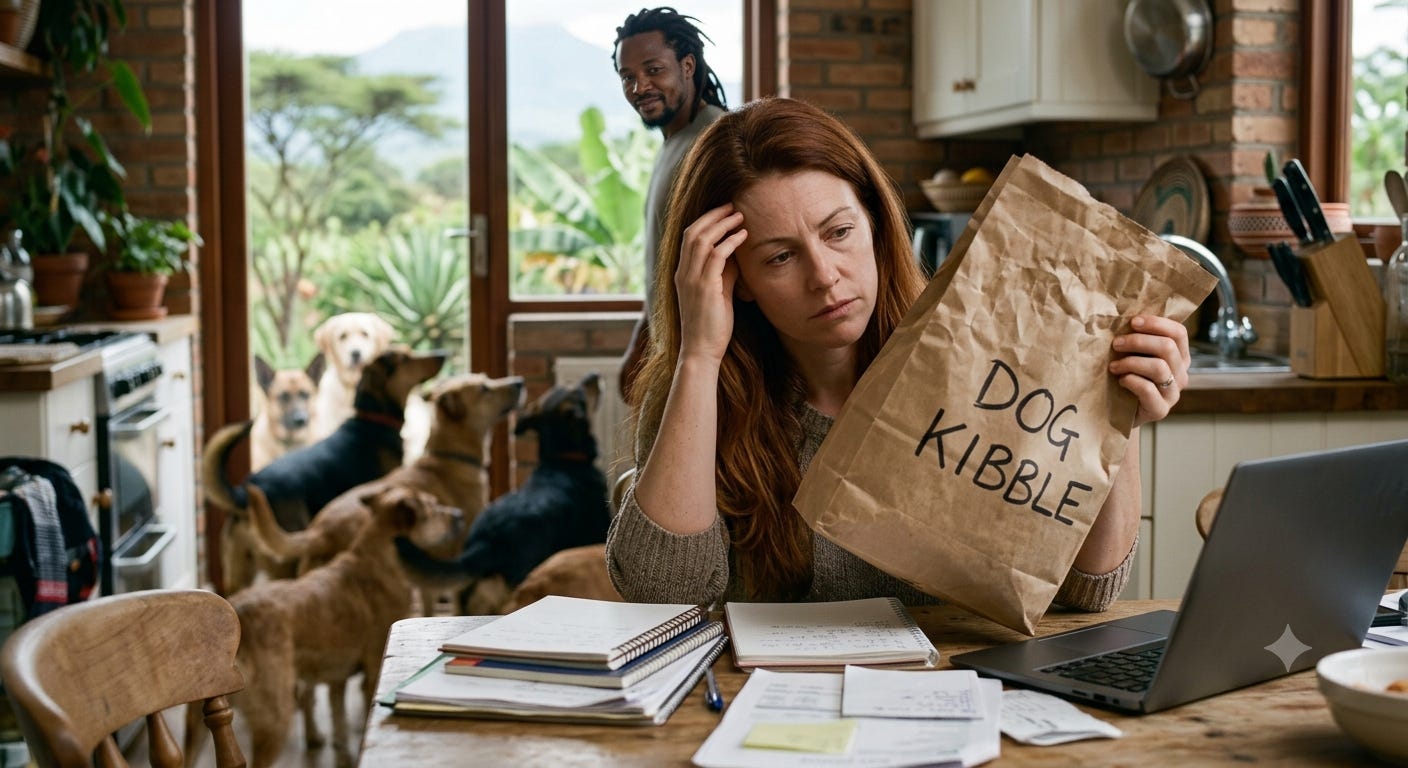
I am writing this from the very edge of my sanity. Brought to you live by an empty bag of dog kibble, I am currently screaming into the digital void so as to avoid screaming at my lovely, clueless husband. To be entirely fair, I saved the actual primal yell for later, well after he had left the house.
The irony is that I am currently on holiday. I am supposed to be relaxing and taking a much-needed break from the relentless demands of my school term. Yet, as any woman reading this will intimately understand, you can set an out of office reply for your emails, but there is no out of office for the cognitive load.
When you are feeding a pack of rescue dogs plus 4 new puppies, running out of food is not a minor oversight; it is a full-blown logistical crisis. My husband was awake for hours before me today. He walked through the kitchen, existed in the exact same spatial dimension as our hungry pack, and yet when I called him later to say we needed dog food, he was shocked. He could have looked. But looking involves seeing, and seeing involves adding an action item to a mental inventory he has never been required to keep. Instead of marching back inside to lose my mind, I took a deep breath, opened my laptop, and chose the void.
It is the absurd theatre of modern womanhood. Our sisters of years gone by burned bras, marched for equality, and fought tooth and nail for the right to enter the workforce, only to discover we had merely signed up for a double shift. We fought for the right to cerebral equality, to sit at the boardroom tables, to balance the ledgers and steer the macro economies, only to discover that the culture outside the office door never updated its firmware. We proved we could do everything, and the world promptly took us at our word, handing over the clipboard of total existence while keeping the baseline expectations for men stuck in a permanent, breezy adolescence. We earned our place in the arena, but we were handed a second shift as a parting gift, expected to wield our intellect in the public square and then come home to manage the invisible world of domestic survival, all while being told we are the architects of our own exhaustion. As the main breadwinner in our house, I spend my days making executive decisions and carrying the heavy financial weight of keeping our lives afloat. Yet I come home to a second, unpaid job where I am the one quietly checking the freezer to make sure there is actual food inside it, making sure the bills are paid before the power gets cut, and noticing - with the weary precision of a seasoned warden - that the bathroom desperately needs cleaning.
That same weary precision follows me every time we open the fridge. When I buy food, I am thinking of cohesive meals and planning ahead for the week. My husband buys food for the immediate, urgent present and with the intent and appetite of a hungry raccoon, completely untroubled by the concept of tomorrow. This apparently looks like six avocados, five chapatis, and a tray of eggs - and god forbid it includes any other vegetable or a balanced meal! I only eat chapatis on occasion, or I get the absolute egg ick every month depending on my cycle….none of this food has my stomach in mind! I like fresh vegetables and fruit, which means I am the one who buys them. He does cook delicious food, to be fair, but it is usually something he would want to eat rather than how I cook, which is always thinking of what he would like and what works for us both. I will intentionally cook a large meal to ensure we have leftovers to ease the burden of the next day, only to wake up and find there are none. The food is simply consumed. The same applies to the rest of the house. If I do not make the bed, no one does. If I do not strip and change the bedsheets, no one does. A holiday for a man is a break from all responsibility. A holiday for a woman is just doing her unpaid management job in comfortable trousers.
It is the exhausting inheritance of domestic legacy. My mum did the exact same thing, carrying the invisible clipboard of our family's weekly shop and mental inventory while the rest of us just lived inside it. I watched her work that quiet, unpaid shift, and I somehow signed the contract to inherit it, patrolling the exact same perimeter with the same tired precision while everyone else enjoys the architecture.
I love my husband. He is genuinely my favourite person, wonderfully kind, and a brilliant partner in a million different ways. But he drives me completely crazy in this domestic arena, because he is simply a product of his environment. Society never teaches men to scan the household landscape; they are raised to be carefree passengers in their own homes, completely oblivious that their partner never applied for the job of permanent chauffeur. It is the unspoken conditioning of boyhood, raising men into a state of blissful domestic blindness just as surely as it grooms girls into relentless hypervigilance. He didn't ask for that conditioning any more than I asked to inherit the mental load.
I saw this play out firsthand in my twenties and even into my thirties. When I lived with female housemates, we naturally shared the load. We would shop together, plan meals together, and keep everything ticking over seamlessly. Then there were the male house-sharers, which felt less like a shared home and more like Neverland, populated entirely by overgrown Lost Boys who treated the kitchen like a set piece from Mad Max. The girls would plan and cook, and the men would just eat it with the enthusiasm of feral toddlers. I had one housemate who thought absolutely nothing of eating an entire pack of bacon for dinner, leaving the kitchen stinking and coated in grease. Another would upturn the entire kitchen to cook his own meal, leaving pots and pans everywhere. We would walk in after a long, exhausting day at work to find not a single piece of kitchenware available and a sink full of dirty dishes, while he had retreated to his room. It is the classic imbalance of communal living, where men lived in a permanent state of vacation while women acted as their uncompensated camp counsellors.
If you think this is just a quirk of marital complacency or young adulthood, it is not. There is a fascinating Channel 4 television experiment from the early 2000s that proved this conditioning starts before puberty. In the documentaries Boys Alone and the subsequent Girls Alone, researchers placed groups of eleven and twelve-year-olds in a house for five days without adult supervision. The boys immediately descended into a literal ‘Lord of the Flies’ chaos, destroying the house, eating sugar until they were sick, and entirely abandoning basic hygiene - giving off major Yellowjackets wilderness energy before anyone even had time to forage for mushrooms. The girls, conversely, immediately organised themselves with the precision of seasoned administrators, cooking meals, cleaning up, and keeping the household functioning. It is the blueprint of our entire social design: we are raising boys to be chaotic passengers and girls to be the designated drivers of domestic life from the moment they can walk.
All of this conditioning culminates in the daily indignity of modern dinner. I will ask what he wants to eat, and he will cheerfully reply, "Oh, you decide!" He thinks he is doing me a massive favour by being easygoing and flexible. He completely fails to realise that "you decide" is a curse. I do not want to decide. After carrying the financial pressure of our household and the cognitive load of our lives all day, I want someone to hand me a plate of food that I did not have to plan, source, purchase, or prepare. It is the daily menu trap, where delegation is disguised as kindness and you are left carrying the entire weight of execution while pretending to be relaxed.
When you zoom out and look at this on a macro level, it is not just about my kitchen. We have built a society that actively relies on female exhaustion to function. We show up, we manage the crises, we pay for the solutions, and then somehow, we are the ones who get labelled as difficult for being stressed by the sheer volume of it all. It is the exact same realisation Gloria lands on in the ‘Barbie’ movie when she talks about the sheer, exhausting impossibility of contradiction just to exist as a woman - how you have to answer for everything, anticipate everything, and somehow make it look effortless while everyone else just gets to live.
Let me be entirely clear: I am not opting out. I love my husband, and I am not trading my life for a solitary studio apartment. But looking at the modern domestic blueprint, it is hard not to notice that we have accidentally built a system where men are living out their own glorious, unironic version of Ken's Mojo Dojo Casa House. They have taken patriarchy and successfully applied it to interior design, convinced that a faux-fur throw, a guitar no one is playing, and a television playing cinematic westerns on a loop constitutes a fully functioning ecosystem. They can comfortably inhabit a chaotic domestic space while expecting a heavily caffeinated Barbie to quietly manage the plumbing, restock the fridge, and negotiate with reality behind the scenes.
We are left holding up Barbie's pristine dreamland entirely by ourselves, complete with sliding closet doors that actually close and matching hangers, while our Kens sit back on oversized armchairs wearing mink coats indoors, entirely untroubled by the fact that the dog kibble has vanished into thin air. They genuinely believe the dreamhouse runs on pure manifestation and feminine intuition, completely oblivious to the industrial-strength engine of invisible labour keeping the lights on.
Look around at the women in your life. We are collectively not okay. We are running on fumes, caffeine, and the sheer terror that if we stop for five minutes, the entire ecosystem of our families will collapse. We do not naturally possess a genetic predisposition for remembering household inventory or managing finances. We have simply been culturally programmed to know that if we drop the ball, absolutely no one else will catch it.
If it is a wonder that the patriarchy has survived as long as it has, it is probably because we have been far too busy keeping everyone alive and paying the bills to dismantle it, treating our daily routines like an episode of ‘The Truman Show’ where we are the only ones who know the set is made of cardboard and unpaid labour.
Imagine a truly shared domestic space. It would not just be women bossing men around, as the old tropes suggest. It would be a system where everyone is actually looked after, where the baseline expectation is communal care rather than individual ignorance. Where the invisible labour is visible, shared, and valued.
And crucially, where someone else checks the bloody dog food.